"Know that you are holy."
Tell me about your faith community?
I'm the co-founder of Havyah, a Jewish intentional community. We're doing a full traditional service in Hebrew that's not in English, that's not interpretive.. But it's being led by queer people, and it's being led by people who would otherwise be kind of left on the margins of Jewish life.
What does queer theology in a Jewish capacity look like for you?
Jewish queer approaches to theology are about knowing the language. There are different levels of learning. You can look at the straightforward linguistic interpretation of what's going on in the Talmud and then you can build on that and eventually get to a place where it's about your personal interpretation of it.
The yeshiva that I studied at in Chicago is called Svara, which is literally intuition and wisdom. We know for a fact that not all pieces of us are welcome at the table at all times. And so sometimes you just kind of have to kick the door in and be like, “Hello, I'm here.” To me, that's what Jewish queerness is. It's about knowing enough that you know exactly where that door is and that you can in fact kick it in, and that you can teach other people to do the same thing.
How did you know that you had a seat at the table, or to put it another way, that you were loved by God?
The moment of knowing that I was loved and valued and at the table was the first time that I had the guts to lead Kiddush, which is this really long, beautiful blessing that you sing over wine on Friday nights. I did it in front of a group of friends after having always been like, “Oh, that's my husband's job or the male head of household's job.” And finally I was like, “What am I thinking? Like, I need to do this.
Do you have any scripture or sacred texts that you connect to?
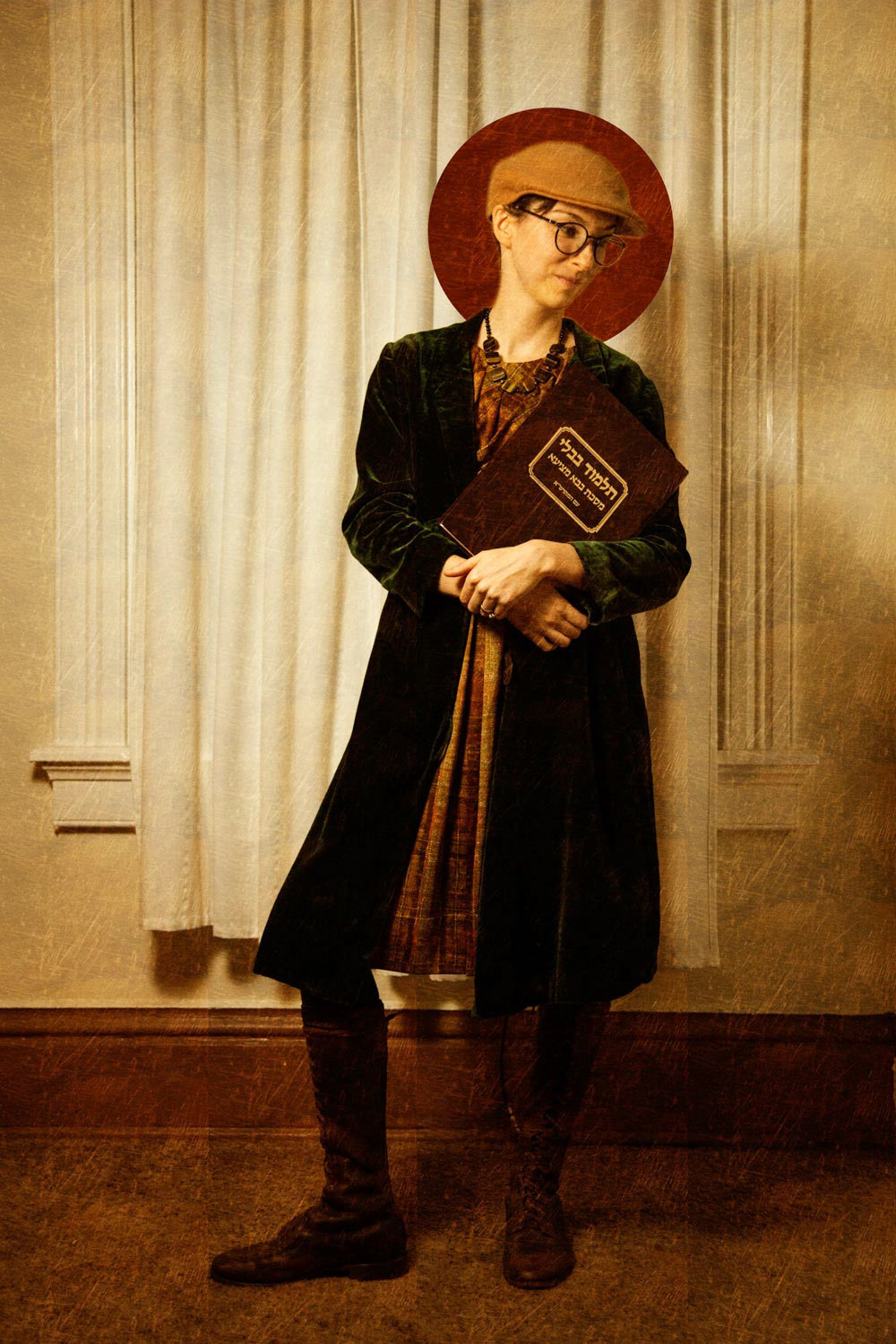
This specific tractate. It's traditionally about this rabbi who's the most beautiful man of all. He's hanging out in the Jordan River naked, getting his swim on. And this man who's a thief and a brigand jumps in and is hiding in the rushes. The rabbi, who's the most beautiful man of them all, is like, “Let me teach you Torah.” While they're naked. How do you not read that as queer?
That was the opening line of the first piece of Talmud that I was taught by my rabbi, Benay Lappe, who is the captain of queering Talmud. And when you read that and you have your lived experience, you're like, “Oh, yeah, I know what's going on here.” Which is very different than how it's taught in heteronormative spaces.
There's so much to be derived from that about how do we have conversations in which we do or don't out each other? How do we have meaningful relationships where we're honest about what those power dynamics mean? How do we sit and have a fight over points of order or philosophy and not cancel one another? How do we get to show up with our entire selves? That is what is so radical and queer about learning Talmud. When it's done right, it is about all of those things.
What advice would you have for other queer people of faith?
You don't have to ditch your religious tradition. Because chances are your religious tradition has been worked by extremists to make it seem as if you are not welcome and you are not loved and you are not holy.
Know that you are holy.