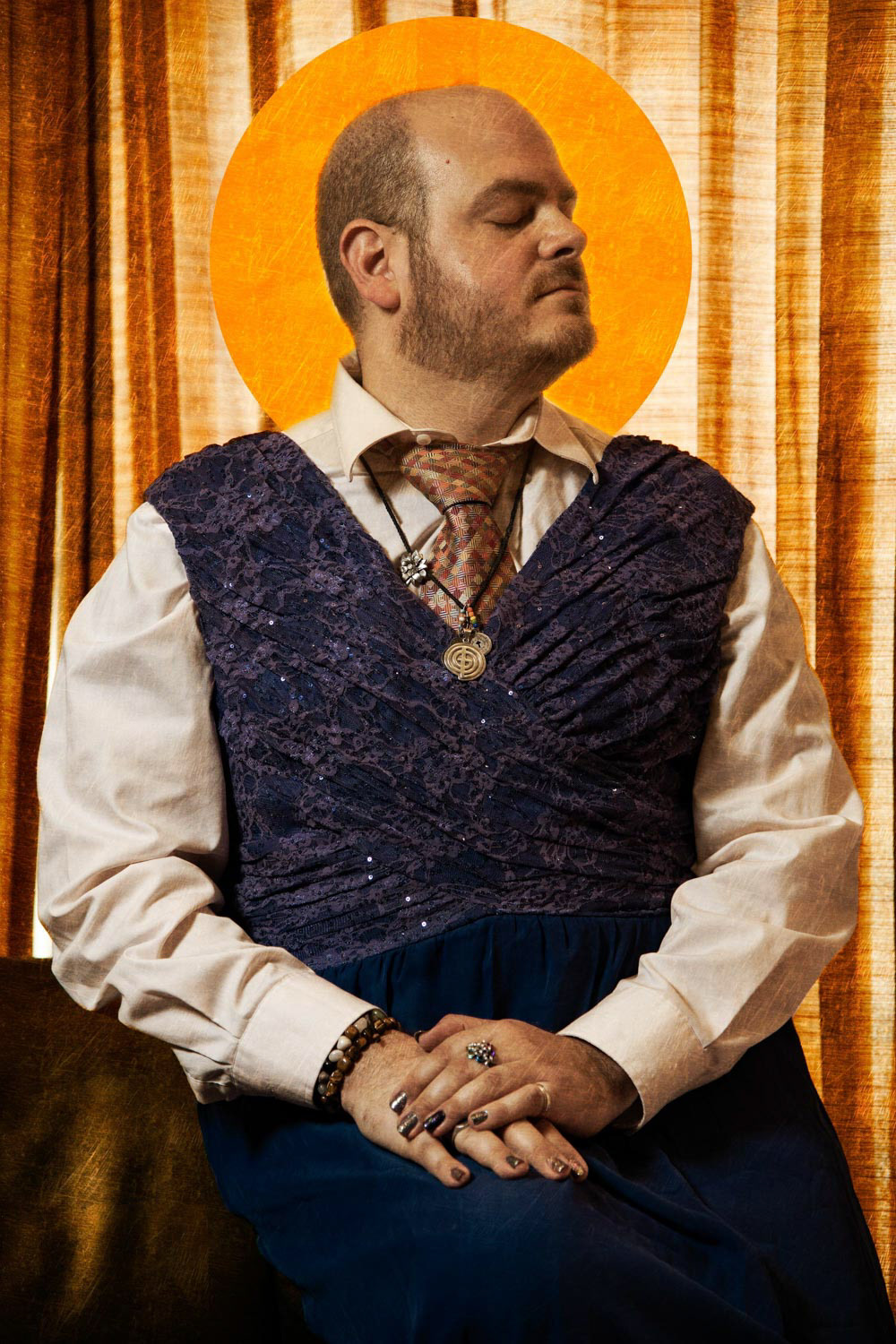
"If I really believe that I’m made in the image of God, then as a queer person, I’m made in the image of a queer God."
How has your queer identity and faith identity intersected?
Initially, I just identified as a religious person growing up. That was the only identity that I fully developed. I was going to be a priest. I was involved in my church. And that's all I was known for. As I got older, came out, came out again, and started exploring myself, a lot of the pain and hurt started to be replaced and healed in many different ways by just being able to claim different religious narratives on my terms. Being able to look at the history, specifically of the Catholic Church, and folks who were transgressive who challenged gender norms. Then being able to expand that to Judaism, which recognizes six genders. I met a rabbi recently who said there may actually be eight genders. And looking at Hinduism and many deities that have many different understandings of gender. So it's been really exciting.
It's remembering. In terms of a cognitive act of remembering and recalling those narratives. But then also re-membering, rebuilding and looking at narratives more wholistically.
Some folks have shared with me that they get uncomfortable anytime I say the word transgressive because they associate it with legality and that it's somehow wrong. And I was like, well, in many cases, especially now, being a person who is trans, who is queer, who is trying to reconcile faith, sexuality and gender, we are breaking the rules. And it is transgressive, but it's a sacred transgressiveness.
I find it ironic in many ways, a lot of the things that I believe and embody now, I at one point in my life thought were sinful and going to lead me to hell. And here I am, the director of an LGBT Center talking to you about faith and sexuality. I don't look at my past with shame. Sometimes I do cringe at some of the things that I used to say. But I'm also proud of that version of delfín and their enthusiasm, sometimes overzealousness for things. And every so often, try to re-funnel some of that youthful stubborn zealousness in more transformative, whole-izing ways.
Tell me about your faith tradition?
I was raised Catholic in a very conservative household. And when I came out, I had a falling out with the Catholic Church, but religion and spirituality were still important to me. So it's been an adventure of trying to find ways to reconcile faith, gender, sexuality, as well as other aspects of identity.
I often get asked if I still identify as Catholic and I think a part of me always will. I think a difference between young delfín and now delfín is practicing it on their own terms and being able to ask questions. And the questions I ask, especially religious questions, I'm not necessarily looking for a specific answer. It's asking questions to explore possibility. That in and of itself is a form of liberation.
In grad school, I had a born again Catholic experience where the goal was to be ordained as an Episcopal priest. But in school discovered queer, and trans, and POC, and intersections of all of that, in more religious writers and religious thinkers. And had a born again moment- this is a side of the church I never knew existed.
I am very kitschy. I think that's part of being Catholic, that we like things, and the symbols and the messages that they spark in us. So a part of me will always be Catholic. But now I sort of identify as church of delfín. I do my own thing. Someone asked me once if I started my own church. No. Now I just say I am a person of faith or a person of spirit.
Still exploring different gender narratives within the religious world and recognizing that religion has documented our existence for centuries and centuries and centuries in very positive uplifting ways. So it's been exciting to discover and rediscover those narratives.
When did you know that you were indeed loved by God?
It would take a couple of years. At first it was, “I'm sinning. Then I'm going to burn in hell and not only am I going to burn in hell, my mom's going to burn in hell and then my sisters are going to burn in hell. We're all going to burn hell together. And what do I do?” I was also in reparative therapy for almost six months. The message that was being instilled in me was that there was something wrong with me. That I could be cured.
I finally just had this moment of, “There's nothing wrong with me.” Do I have my issues? Yes. But at that time my sexuality was not one of them. I need to figure this out for myself. If I really believe that I’m made in the image of God, then as a queer person, I’m made in the image of a queer god. That was just very revolutionary to me at the time.
Do you have any passages of scripture or sacred texts that resonate with you?
A text that over the last few years has taken on a new significance, are the resurrection narratives, and being able to reinterpret them from a trans perspective. Just sort of Jesus, in some ways, coming out as trans in the resurrection and what that means for folks like me today. And so those stories have meant a lot.
Mostly the general narrative of Jesus being recognized in his wholeness for the first time and being able to look at his scars, which weren't erased, were still there. And thinking of when folks have gender affirmation surgery, the scars that they have, and or scars from other life events, they take on new meaning. They're not erased. They're still there, but don't define us. Don't define Jesus. And so looking at the narrative, Jesus revealing his wholeness to the world and having the world not fully understand that. Just like many of us.
Mostly the general narrative of Jesus being recognized in his wholeness for the first time and being able to look at his scars, which weren't erased, were still there. And thinking of when folks have gender affirmation surgery, the scars that they have, and or scars from other life events, they take on new meaning. They're not erased. They're still there, but don't define us. Don't define Jesus. And so looking at the narrative, Jesus revealing his wholeness to the world and having the world not fully understand that. Just like many of us.
What advice would you have for other queer people of faith?
The first piece of advice is you're not alone. There is community out there. And community broadly defined. Sometimes it's in real life, in person. Sometimes it is virtual. Whether it's Facebook, TikTok, Instagram, internet as a whole- there is community there. Connect with that community to be reminded that one is not alone.
The second piece of advice is just to keep asking questions. Ask questions, ask questions, ask questions. There's nothing wrong with asking questions. At first, when I started asking questions, I felt that made me less than. It took awhile to recognize that no, it's okay to ask questions. It's okay to be curious. It's okay to explore and for narratives to become very messy and complicated. And that can be very overwhelming. It can be very intimidating. But if we're able to get past that initial overwhelmingness, you are introducing a whole transformative, whole-izing world that has always been there. We've just not been allowed to really experience it.
What do you see as your ministry?
I really see directing the LGBT Center at OU, here, the Cantu Queer Center. This is my ministry. When a person is in my office sharing the fear of coming out or the joy that they experienced by being able to wear a binder for the first time. Both those moments- it’s a form of ministry. I'm not reverend in that moment, but it's still ministering in every sense of the term ministry. So the work that I have done in higher ed, for me, is my ministry. Just being able to introduce folks to possibility, in the religious world as well as outside of the religious world.
Right now, I'm just a lay person who has the same credential as a person who's ordained. When I'm counseling someone, supporting someone, connecting a person to resources, speaking at rallies, facilitating workshops- it's a different form of preaching. It's a different form of pastoral care.