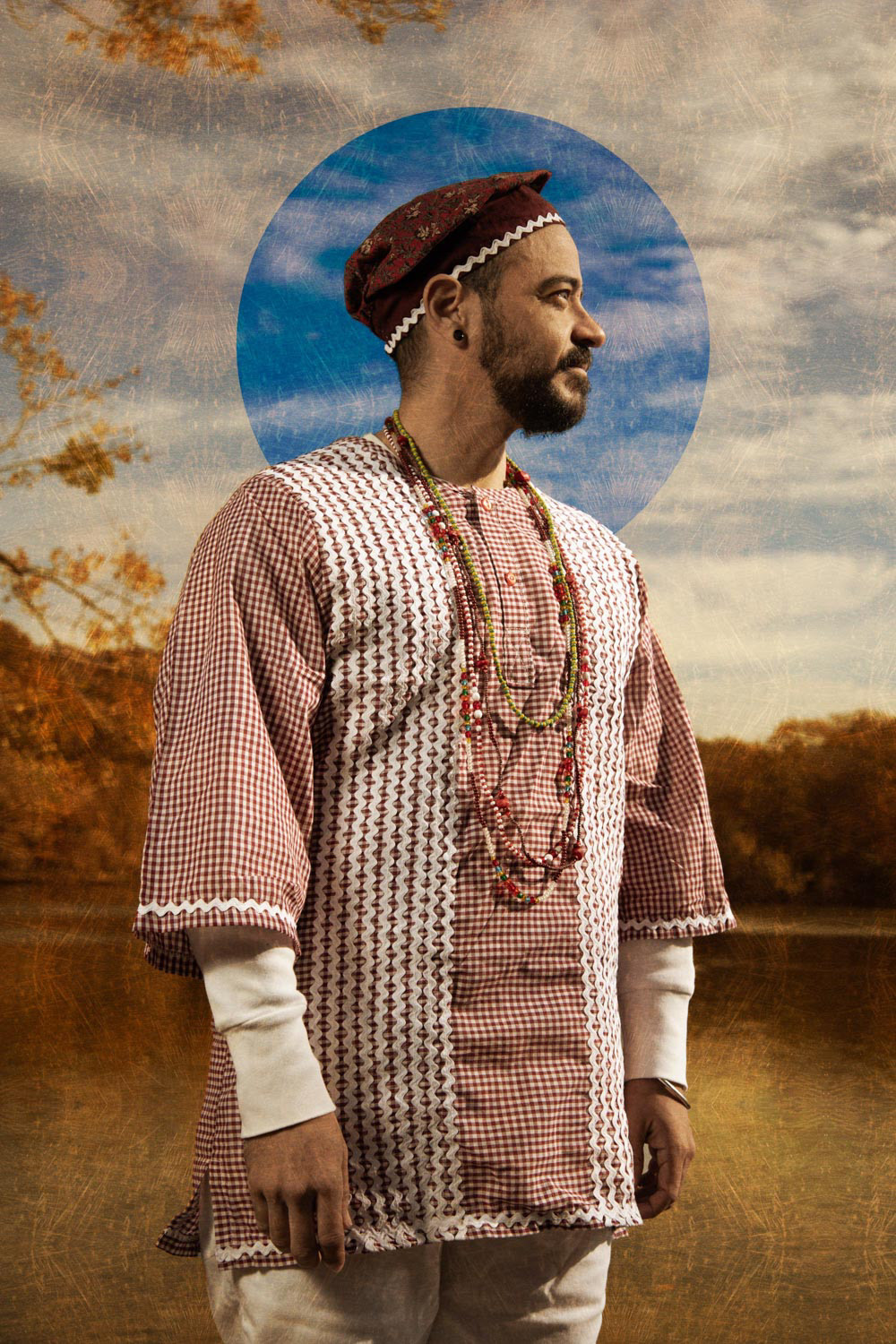
"My queer and trans identity is intrinsic to my spiritual journey."
How did you know that you were loved by God?
It's interesting because it was through story, and embodied listening. My mom was a storyteller. I grew up listening to all her stories. Her most dramatic one was reserved for my birthday since I was born breech and was her rainbow baby.
It was 7:30 in the morning and no nurse was around because the city was administering a census count and the entire team went to a room to be counted. My mom felt and then saw my foot which scared her to the point of yelling at the top of her lungs “I need a nurse! Help! I need a nurse!” for a good ten minutes. Finally, a nurse responded to her apologetically and brought in a team to help deliver me. I was born by 8 AM. She would always end the story with, “You were meant to be here to fulfill your destiny, as a gift to this world!” Every birthday, that story would fill me with a sense of purpose and belonging. As a rainbow baby, my connection to spirit began in the magical threshold of spirit, my mother’s womb.
My experiences as a clinical chaplain resident in the birth center and NICU during the height of the pandemic taught me to honor my life as a blessing through every shade of the rainbow. Accompanying birthing parents as well as premature babies through brief and unfortunate extended stays reminded me to share the love and purpose my Mom instilled in me.
My queer and trans identity is intrinsic to my spiritual journey. As a Lucumí babalorisha (Santero priest) I perceive my trans self as a microcosm within a permeable pluriversal landscape–both material (seen) and non-material (unseen). Guided by the stories of my ancestors, spirit guides, and Orichás.
When I think about the ways that transness is understood, the spiritual component is often left out. While I always felt an excess of spirit within me and around me, I did not have the access to my own embodied knowledge. Being a part of trans justice activism gave me a sense of collective purpose and led me to my affirming ilé (Lucumí spiritual family).
Do you have any scripture or sacred texts that you connect to?
Octavia Butler's Parable of the Sower is a text I often come back to. Butler names her protagonist, Lauren Oya Olamina, and in Lucumí Oya is the Orichá that represents change in all its transitional forms as the owner of the wind.
“God is change.
All that you touch, you change.
All that you change, changes you.
The only lasting truth is change.
God is change.”
What I bring to the table is the acceptance of change.When creating spaces for folks to bring their whole selves to, I also have to do the work of spiritual maintenance to welcome presence. Sometimes people just need to land, breathe, and say things that they're uncomfortable saying. Western social constructs are continuously sucking life out of most spaces let alone our own bodies. I tend to confront challenges by reciting Octavia Butler's five stanzas out loud as a reminder that it is all about change. Being in tune with breath has shown me that not one breath is the same.
What advice would you give to queer people of faith trying to figure out how their identities fit together?
In one of my divinity school classes, we were asked what was your first theological encounter? And write about it in auto-narrative form. The question was not Christo-centric or specific to an Abrahamic tradition. When was the first time that you actually felt loved by God? And seen by God, held by God? Where something magic interceded?
I would ask them that. When was the first time that you felt magic intervene on your behalf? I would start there. What were the conditions that created that? What do you hold from that moment? And how does that inform your practice today in queer community, in your spiritual community? Or how do you want it to inform your practices? How would you want to create that for you and your community now? More questions than answers.
What are your prayer practices?
Each week, I sit with my spiritual altar and call on my spirit guides, ancestral guides, my family members, my godparents, and our religious lineages. It creates a protective network of prayer. A way of manifesting is by naming. When calling on the positive energy of various lineages, there's an energetic network that responds.
What is Santeria?
Lucumí (Santeria) is a Afro-diasporic religion that practices ancestral veneration or espiritismo which consist of creolized elements from West African Yoruba Egungun, folk Catholicism, Central African Kongolese Palo Monte, and European Kardecian Spiritist practices of the Caribbean. Lucumí is rooted in Afro-Indigenous cosmologies and is not compatible with Western philosophical and theological categories, since there is no formal distinction between the sacred and the secular. There are two realms and the boundary between the visible (material) and the invisible (spiritual) is permeable. Olódùmarè, creator of the universe sends messages that are communicated to the visible realm are mediated by the orichás, the divine beings living in the universe. They represent elements of the natural world. Our ritual practices are widely known through the presence or transcorporeality of orichá, during ritual drummings.
What does it mean to be a Santeria Priest?
I live in a pluriversal reality as a Lucumí babalorisha, and find that people generally gravitate to a spiritual practice when they can't understand something, they dreamt about or are in need of additional guidance. I believe that every person comes spiritually equipped, it is just a matter of knowing who you come from and learning about the collective spiritual fabric that you are made of.
When working with others I mostly learn about their family lineages to get an idea of spiritual religious practices that are a part of their spiritual lineage. I listen for any information that needs to be mediated. I encourage folks to build their own practice and guide them with some basic tools and resources. Spiritual practice is a reciprocal practice. Before any other spiritual work is done, there's a veneration to the ancestors. I collectively guide folks (with my ancestors and guides) to work with their own ancestral guides. This guidance reminds folks that their hands and embodied knowing and listening is also putting in the work. It's their spiritual energy that ultimately will align their path. Not mine. Everything is a part of you.